
For decades, seasonal waxing was the unquestioned gold standard for preserving fiberglass gelcoat and marine paint. Every spring, boat owners, yacht captains, and shipyards invested countless hours into compounding, polishing, and buffing paste carnauba or synthetic polymers onto hulls and superstructures.
Yet in modern marine operations, traditional waxing is rapidly being phased out in favor of advanced nano-ceramic molecular coatings. Why are professional captains, refit managers, and superyacht owners abandoning marine wax?
In this comprehensive guide, we examine the chemical mechanisms, real-world longevity, maintenance requirements, and 5-year cost breakdown of ceramic coating vs marine wax in harsh saltwater environments.
The Chemistry of Marine Wax: Why Traditional Wax Fails in Saltwater
To understand why traditional marine wax breaks down so quickly, you must examine how it interacts with boat surfaces at a microscopic level:
- Physical vs. Chemical Adhesion: Traditional boat waxes (whether carnauba, montan, or synthetic silicone polymers) do not bond chemically to gelcoat or polyurethane paint. They merely sit atop microscopic surface pores, held by weak physical surface tension.
- Low Thermal Threshold: Standard marine waxes have a relatively low melting point (often between 60°C to 82°C / 140°F to 180°F). On dark hulls or bright sun-exposed decks in the Mediterranean, the Caribbean, or Florida, gelcoat surface temperatures routinely exceed 65°C. At this temperature, the wax softens, liquefies, and acts like a magnet for airborne soot, industrial fallout, and salt crystals.
- Solubility Under Detergents and Salt Spray: Every time a boat slices through saltwater or undergoes standard deck washdowns with marine soaps, the friction and salinity strip away layers of wax. Within 6 to 10 weeks, the protective barrier is completely depleted, leaving porous gelcoat unprotected against UV radiation.
How Marine Ceramic Nanocoatings Work: The Molecular SiO2 Shield
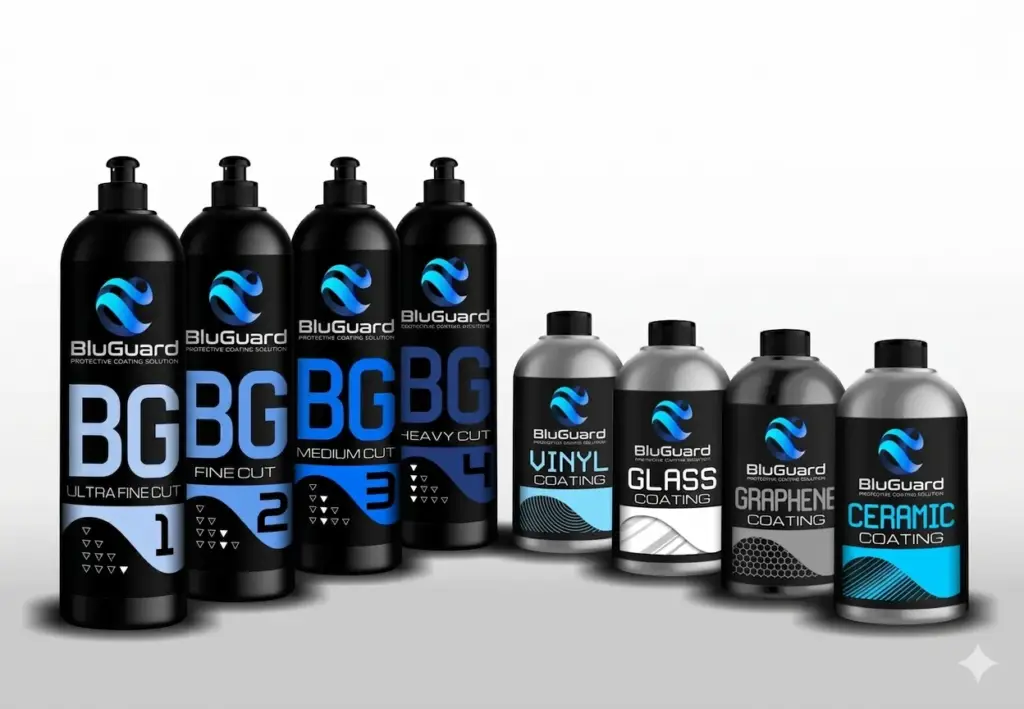
Unlike wax, BluGuard Marine Ceramic Coatings utilize advanced nanotechnology formulated specifically for marine substrates.
Rather than resting loosely on top of the surface, liquid silicon dioxide (SiO2) and titanium dioxide (TiO2) nanoparticles penetrate the microscopic pores of gelcoat, clearcoat, and vinyl wraps:
- Covalent Cross-Linking: As the coating cures, it forms an unbreakable covalent chemical bond with the substrate, effectively transforming into a permanent, transparent ceramic quartz shell.
- Hydrophobic Self-Cleaning Effect: The coating produces a water contact angle greater than 110°, causing water to form tight beads and roll off instantly, carrying salt deposits, scum, and exhaust soot along with it.
- Thermal & Chemical Immunity: Cured nano-coatings are thermally stable up to 500°C (932°F) and completely impervious to harsh sea salts, bird droppings, acid rain, and marine detergents between pH 2 and pH 12.
Head-to-Head Comparison: Marine Ceramic Coating vs. Traditional Boat Wax
| Feature | Traditional Marine Wax | BluGuard Marine Ceramic Coating |
|---|---|---|
| Bonding Mechanism | Mechanical film (sits on top) | Covalent molecular cross-linking |
| Typical Durability | 2 to 3 months in saltwater | 2 to 5+ years with basic maintenance |
| UV Protection | Low (absorbs UV & degrades) | 99.8% UV-A and UV-B blocking |
| Scratch Resistance | None (soft organic layer) | High (9H pencil hardness rating) |
| Washdown Effort | Heavy scrubbing & harsh soaps required | Rinse with fresh water; 50% water reduction |
| Exhaust Soot Resistance | Sticks directly into softened wax | Wipes off effortlessly with a microfiber cloth |
| Reapplication Frequency | 3 to 4 times per year | Once every 2 to 5 years |
5-Year Maintenance Cost Analysis: Is Ceramic Coating Really More Expensive?
A common hesitation among vessel operators is the upfront investment: professional ceramic coating requires thorough surface decontamination, multi-stage machine polishing, and controlled application, making initial application costs higher than a standard wax job.
However, when analyzing the total cost of ownership across a 3- to 5-year operating window, ceramic protection yields substantial net savings:
- Waxing Cycle (5 Years): A 40-foot boat typically requires full compounding, polishing, and waxing at least 3 times annually. At an average professional rate of $35–$50 per foot per session, maintenance totals $21,000 to $30,000 over five years—not including downtime and fuel burn from increased hull drag as wax degrades.
- Ceramic Coating Cycle (5 Years): A premium ceramic application with thorough gelcoat correction represents an upfront investment of $4,500 to $8,000. For the following 36 to 60 months, seasonal labor is reduced to routine decontamination washes and occasional top-coat inspections. Total 5-year expenditure typically remains under $10,000 to $12,000.
- Direct Operational Savings: Because treated hulls exhibit superior slickness and hydrodynamics, vessel operators report immediate wash time reductions of up to 50%, zero need for aggressive acid hull cleaners, and measurable reductions in wash water consumption.
Read more about maximizing vessel budget efficiency in our analysis on reducing yacht maintenance costs.
Marine Wax vs. Car Wax: Can You Use Automotive Products on a Boat?
A frequent question from boat owners is whether automotive waxes or car ceramic products can be applied to marine gelcoat.
The short answer is no. Automotive clearcoat is thin (around 30–50 microns) and rigid, whereas marine gelcoat is significantly thicker (500–800 microns), substantially more porous, and subject to constant structural flex and relentless saltwater immersion. Automotive coatings lack the specialized UV inhibitors, flexibility, and marine salt barrier chemistry required to prevent gelcoat chalking and oxidation.
Always select an engineered marine coating solution designed specifically for nautical conditions.
Frequently Asked Questions (FAQ)
How long does a marine ceramic coating last compared to boat wax?
While standard carnauba and polymer waxes degrade within 60 to 90 days in saltwater environments, a professionally applied marine ceramic coating provides 2 to 5 years of continuous gloss and hydrophobic protection.
Can I apply wax over a ceramic coating?
It is not recommended. Applying wax over a cured ceramic coating masks the superior hydrophobic and self-cleaning properties of the ceramic layer. The wax will attract dirt and dust, degrading the slickness of the ceramic finish until it washes away.
Does ceramic coating prevent waterline scum and marine growth?
While ceramic coatings are not antifouling paints and do not prevent hard marine growth (such as barnacles) on permanently submerged running gear, their ultra-slick surface dramatically reduces the adhesion of saltwater scum, brown waterlines, and salt crust, allowing them to be rinsed off with fresh water.
Can ceramic coating restore oxidized gelcoat?
Ceramic coating protects the surface, but it cannot fix existing oxidation underneath. The boat must undergo proper multi-stage marine compounding and polishing to eliminate oxidation, scratches, and chalking before the ceramic coating is applied to lock in the mirror finish.
Ready to Elevate the Protection of Your Vessel?
Protecting your marine investment requires technology engineered for the open sea. Whether you manage a private center console, a commercial charter fleet, or a luxury superyacht, BluGuard provides molecular-level surface protection that outlasts traditional wax by years.
Request an expert consultation with BluGuard today to discover custom protective solutions for your vessel.